
40Hz Audiovisual Stimulation May Slow Cognitive Decline in a Subset of Alzheimer's Patients
GemPagesAn open-label extension study recently published in Alzheimer's & Dementia provides the first investigation into the potential long-term (up to 2 years) effects of daily 40Hz gamma-frequency audiovisual stimulation on cognitive function and biomarkers in patients with mild Alzheimer's disease (AD). This research offers new data on the long-term safety and efficacy of this non-invasive treatment approach.
Study Design and Long-Term Safety
The study involved five mild AD patients who, following the conclusion of the original clinical trial, opted to continue daily, at-home treatment with one hour of 40Hz light and sound stimulation (GENUS therapy) for approximately two years. No serious adverse events related to the stimulation therapy were reported throughout the study period, demonstrating the safety and feasibility of this long-term, home-based regimen.
Significant Divergence in Neural Response
Researchers used electroencephalography (EEG) to assess the brain's response to the 40Hz stimulation (neural entrainment) (Figure 1).
1. Enhanced Response in Late-Onset AD: In three female patients with late-onset AD (LOAD), the 40Hz power in their EEG signals in response to GENUS stimulation showed significant increases after approximately 30 months compared to baseline (by 109%, 164%, and 113%, respectively), rather than a decline.
2. Weakened Response in Early-Onset AD: In contrast, two male patients with early-onset AD (EOAD) exhibited substantial decreases in their EEG's 40Hz response power after long-term treatment (reducing to 38% and 32% of baseline levels).
This result indicates that GENUS therapy can continue to effectively induce neural oscillations in LOAD patients over time, while its effect may diminish in EOAD patients.
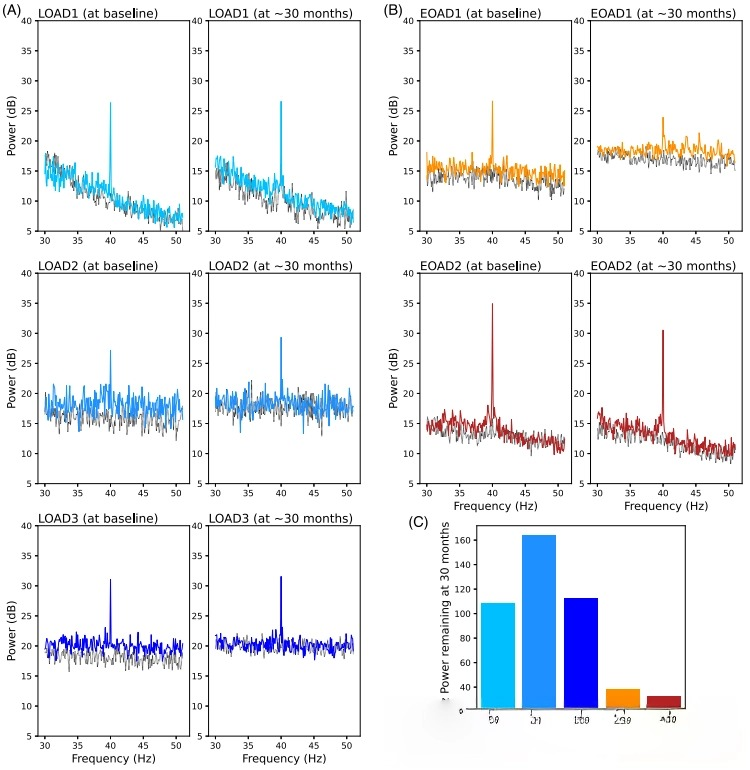
Figure 1: After approximately 30 months of long-term 40Hz GENUS therapy, patients with late-onset Alzheimer's disease (LOAD) showed an enhancement in 40Hz neural entrainment power measured by EEG, whereas patients with early-onset Alzheimer's disease (EOAD) exhibited a significant decrease in this response power.
Changes in Cognitive Function
The study compared changes in participants' cognitive scores with matched controls from the NACC, ADNI, and LEADS databases (Figure 2).
1. Clear Benefit for LOAD Patients: The three female LOAD patients showed significantly slower annual rates of decline on the Mini-Mental State Examination (MMSE), Clinical Dementia Rating (CDR), and Functional Activities Scale (FAS) compared to their matched controls. Statistical analysis confirmed significant differences on the MMSE, CDR-Sum of Boxes (CDR-SB), and FAS.
2. No Significant Advantage for EOAD Patients: The changes in cognitive scores for the two male EOAD patients did not show a consistent pattern of improvement or stabilization compared to controls.
This suggests that long-term GENUS treatment may be more effective in slowing cognitive and functional decline specifically in LOAD patients.
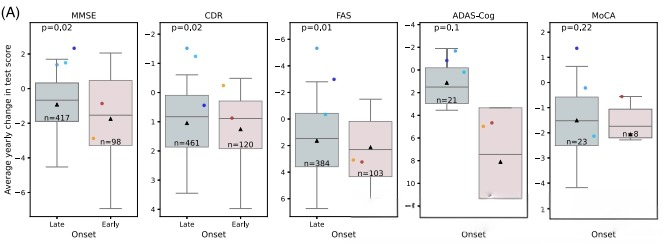
Figure 2: Compared to matched controls from large-scale databases, the three patients with late-onset Alzheimer's disease (LOAD) receiving long-term 40Hz GENUS therapy exhibited significantly slower rates of decline in scores on the MMSE, CDR, and FAS cognitive assessments. In contrast, the two patients with early-onset Alzheimer's disease (EOAD) showed no comparable clear benefit.
Trends in Brain Structure Volume
MRI scans measured volume changes in AD-related brain regions (e.g., hippocampus, temporal lobe) (Figure 3). While LOAD patients showed a trend toward reduced brain atrophy, the difference compared to controls did not reach statistical significance.
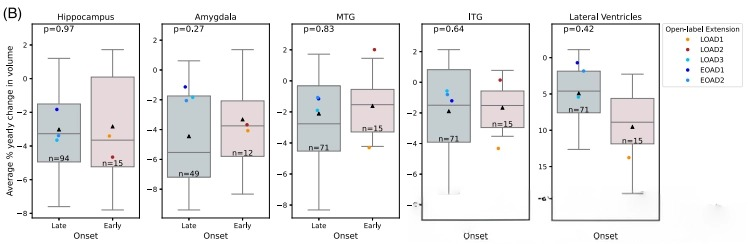
Figure 3: Compared to the control group, patients with late-onset Alzheimer's disease (LOAD) receiving long-term GENUS therapy showed a trend toward slower rates of atrophy in temporal lobe structures (such as the hippocampus and amygdala) and slower expansion of the lateral ventricles, though these differences did not reach statistical significance.
Significant Reduction in Key Biomarker Plasma pTau217
Phosphorylated Tau217 (pTau217) in plasma is a key biomarker of AD pathology (Table 1).
In the two LOAD patients for whom long-term blood samples were available, daily GENUS therapy for approximately two years led to reductions in their plasma pTau217 levels by 47% and 19% (54.9% and 19.2% after total protein correction, respectively).
This is the first report linking a non-invasive sensory intervention to reduced plasma pTau217 levels in human AD patients, implying that GENUS therapy may have a direct biological impact on slowing the core pathological process of AD.
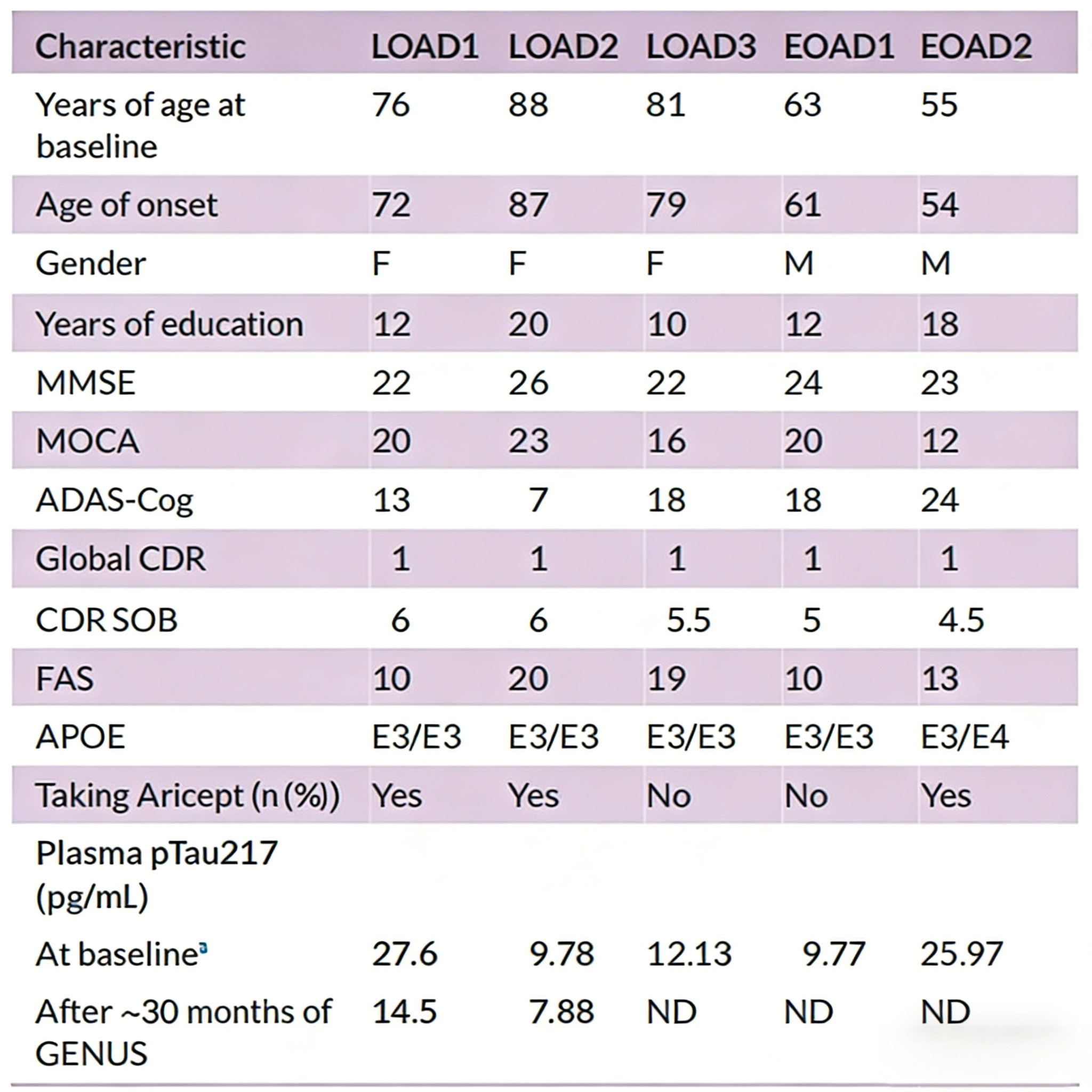
Table 1: Demographic and baseline clinical characteristics of the five Alzheimer's disease patients, showing that plasma pTau217 levels significantly decreased by 47% and 19%, respectively, in the two patients with late-onset AD (LOAD) following long-term GENUS intervention.
Improved Sleep-Wake Rhythms
Actigraphy monitoring revealed improved circadian activity rhythms in some participants, characterized by reduced intraday variability (less fragmented activity) and increased daytime stability (stronger synchronization with the external environment). This aligns with prior short-term study results, indicating that GENUS may help stabilize sleep and circadian rhythms in AD patients.
Summary and Future Directions
This small-scale, long-term pilot study indicates that GENUS therapy is a safe and potentially beneficial long-term intervention for patients with mild Alzheimer's disease, particularly those with the late-onset form. The potential benefits include slowing cognitive decline, improving circadian rhythms, and possibly reducing the key AD pathological biomarker pTau217.
The findings highlight a potentially differential treatment response between LOAD and EOAD patients, providing crucial preliminary evidence and direction for future larger-scale, long-term randomized controlled trials.
Diane Chen, Gabrielle de Weck, Brennan L. Jackson, et al. Gamma sensory stimulation in mild Alzheimer's dementia: An open-label extension study. Alzheimer's Association. Volume21, Issue10. October 2025.E70792
https://alz-journals.onlinelibrary.wiley.com/doi/10.1002/alz.70792


