
40Hz Auditory Stimulation for Alzheimer's Disease: First Evidence of Long-Term Efficacy in an Aged Primate Model
GemPagesAlzheimer's disease (AD) is the most common neurodegenerative disorder worldwide, with no currently available methods to reverse or halt its progression. In recent years, a non-invasive therapy based on "40Hz" physical stimulation has shown promise in animal studies, but its efficacy in larger animal models more closely resembling humans has remained unverified.
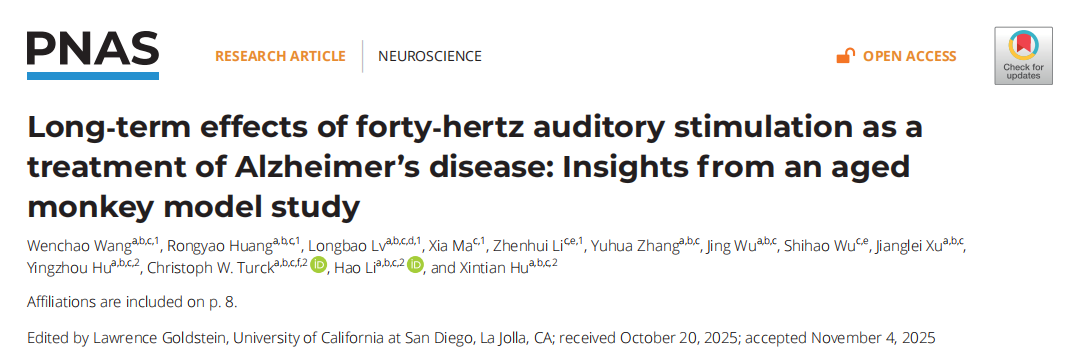
Recently, a research team from China achieved a breakthrough. They have completed the first study of its kind in aged non-human primates (rhesus monkeys), with the findings published in the prestigious journal PNAS, lending stronger support to this potential future therapy.[1]
I. What is 40Hz Stimulation?
40Hz falls within the range of high-frequency gamma oscillations generated by brain network activity. Research has found that these oscillations are weakened in both AD patients and AD mouse models. In 2016, an MIT team discovered that stimulating AD model mice with 40Hz flickering light could induce gamma oscillations and reduce amyloid-beta (Aβ) deposits in their brains. Subsequent research expanded to auditory stimulation, also showing potential for improving cognitive function.
II. Why Use Monkeys for the Experiment?
Although mouse studies provide crucial insights, their brain structure and function differ significantly from humans, and mice do not naturally develop AD. Aged rhesus monkeys, however, spontaneously develop Aβ plaques similar to those seen in humans as they age, making them a more ideal model for studying AD.
III. How Was the Study Conducted?
Researchers divided nine aged monkeys (26-31 years old) into three groups:
1.Experimental Group: Received 7 days of 40Hz pure-tone stimulation for 1 hour daily, followed by a 21-day interval, and then 7 days of random sound stimulation.
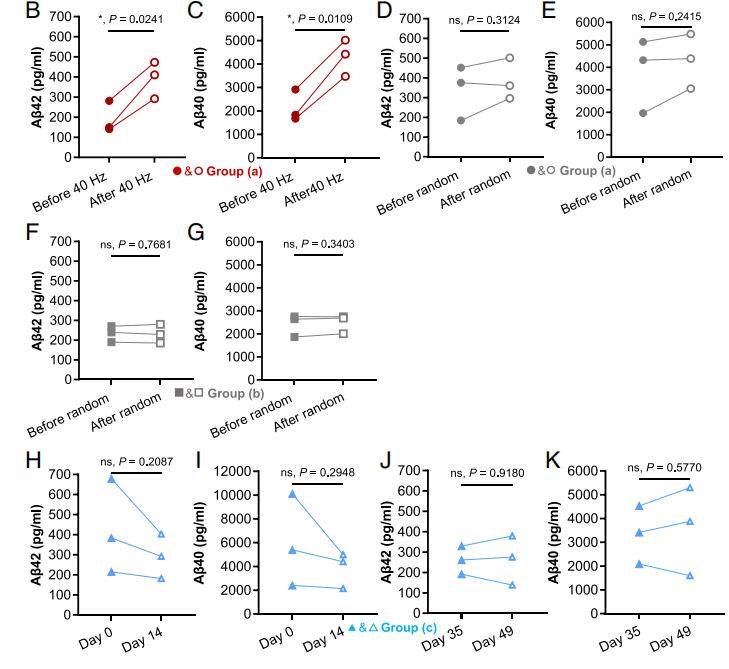
2.Random Stimulation Control Group: Received only random sound stimulation.
3.Blank Control Group: Had a speaker placed nearby but no sound was played.
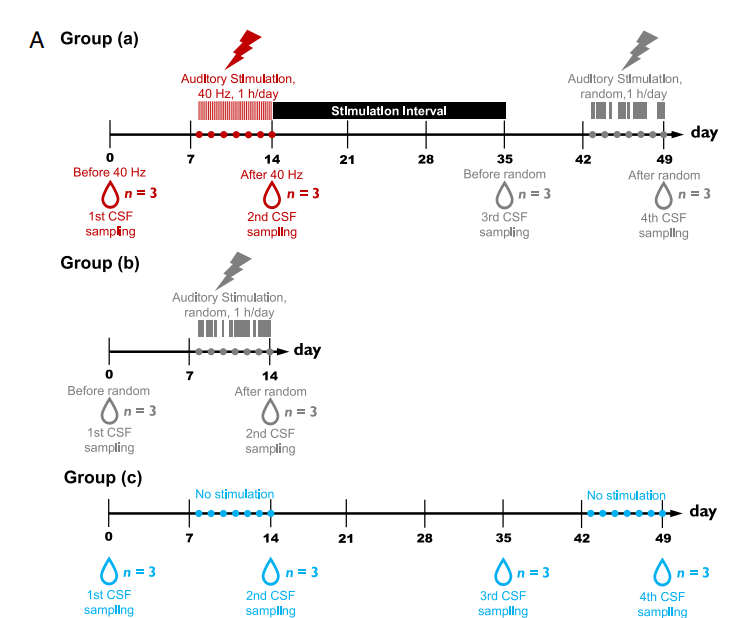
The study monitored changes in Aβ and Tau protein levels by collecting cerebrospinal fluid (CSF)—the abnormal accumulation of these proteins is a core pathological hallmark of AD, and their CSF concentrations are highly correlated with the severity of pathology in the brain.
IV. What Did They Find?
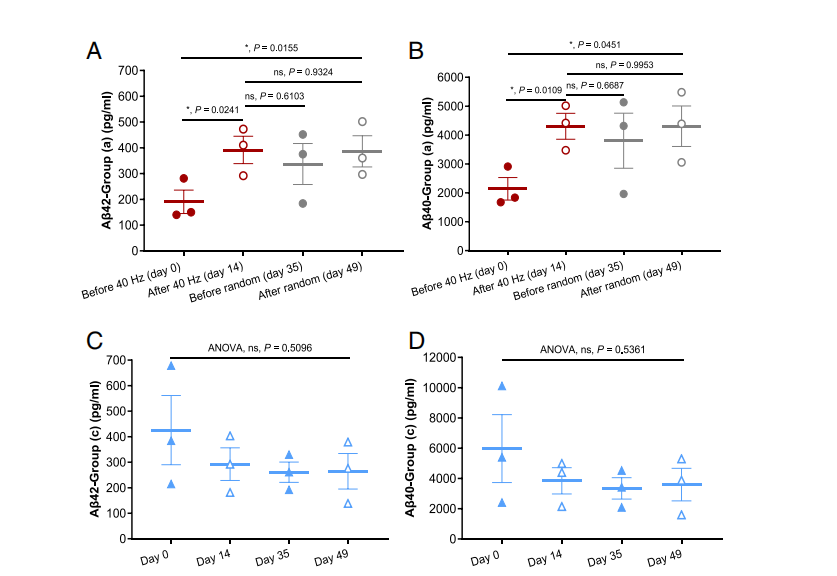
1.Rapid Increase in CSF Aβ Levels: Just 7 days of 40Hz stimulation caused CSF levels of both Aβ40 and Aβ42 in the experimental group monkeys to rise rapidly by approximately 200%. Neither random stimulation nor the blank control produced this effect.
2.Unexpectedly Long-Lasting Effect: More surprisingly, this elevation in Aβ levels persisted for over 5 weeks (35 days) after the stimulation stopped. Previous rodent studies typically showed effects diminishing shortly after cessation.
3.Minimal Impact on Tau Protein: The 40Hz stimulation did not cause significant changes in CSF levels of total Tau or phosphorylated Tau protein.
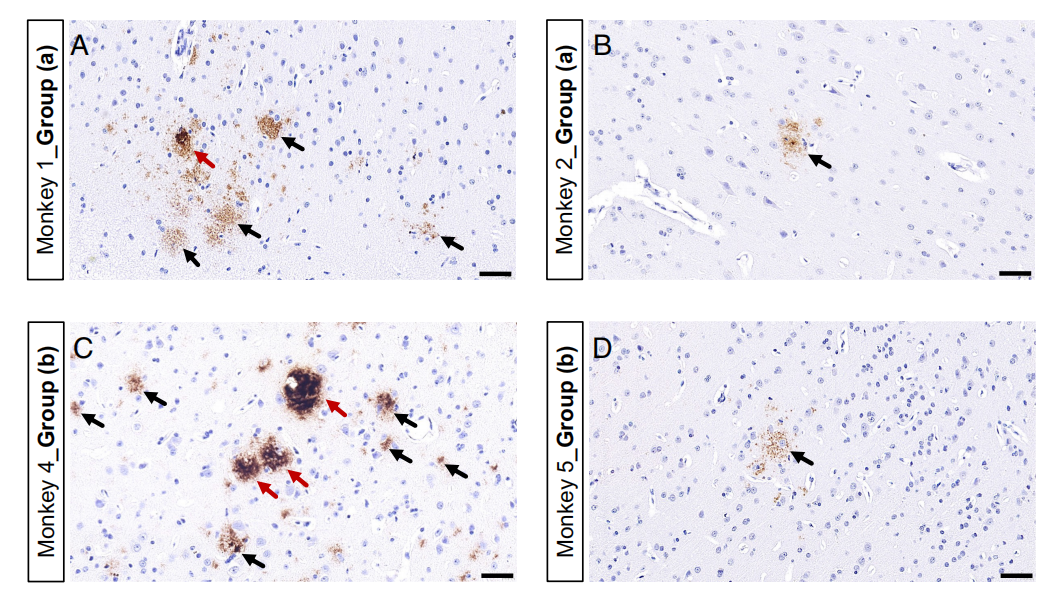
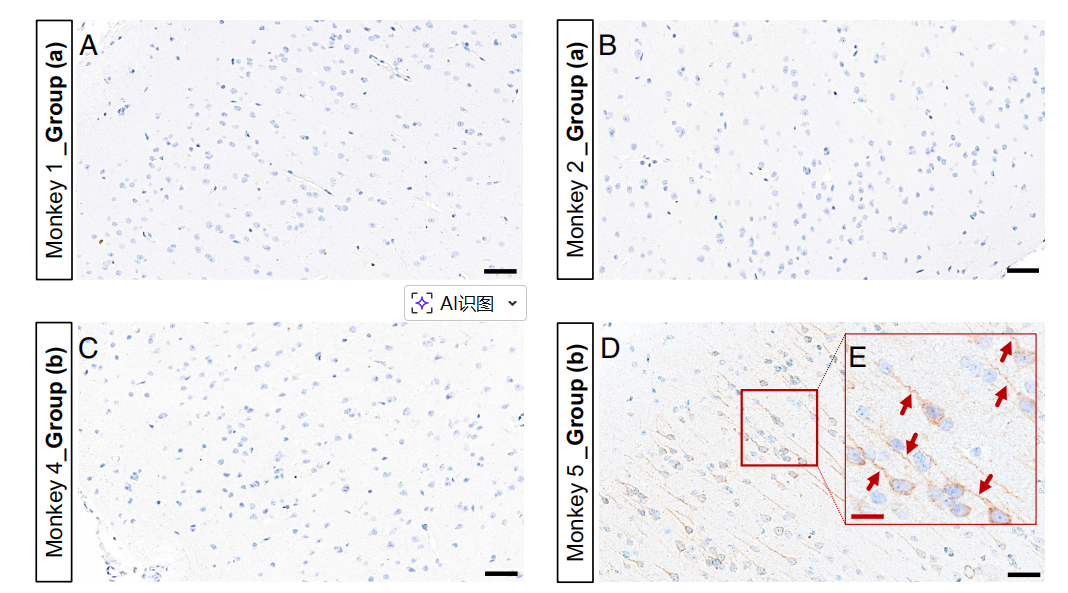
Post-mortem pathological findings supported these results: Examination of brain tissue from some monkeys revealed evident Aβ plaques in the temporal cortex (where the auditory cortex is located), but pathological deposition of phosphorylated Tau protein was almost undetectable. This clearly explains why CSF Aβ levels changed significantly while Tau levels remained stable.
V. What Does This Mean?
The researchers propose that the sustained increase in CSF Aβ levels may result from the 40Hz stimulation activating the brain's "glymphatic system," thereby enhancing the clearance of Aβ from the brain's interstitial fluid into the CSF. This study provides the first evidence in primates that 40Hz auditory stimulation can induce long-term modulation of brain Aβ metabolism, offering crucial support for its potential as a non-invasive therapy for AD with minimal side effects.
VI. Summary and Future Directions
This pioneering study in monkeys demonstrates that 40Hz auditory stimulation can safely and durably influence Aβ metabolism—a process closely linked to AD. While its long-term therapeutic efficacy and specific impact on cognitive function require further investigation, it undoubtedly opens a new and encouraging avenue in the fight against Alzheimer's disease.
[1]Wenchao Wang, Rongyao Huang, Longbao Lv, et al.Long-term effects of forty-hertz auditory stimulation as a treatment of Alzheimer’s disease: Insights from an aged monkey model study. PNAS. January 5, 2026 Vol. 123 | No. 2
https://www.pnas.org/doi/10.1073/pnas.2529565123


